Human or Machine: Who will Take the Lead?
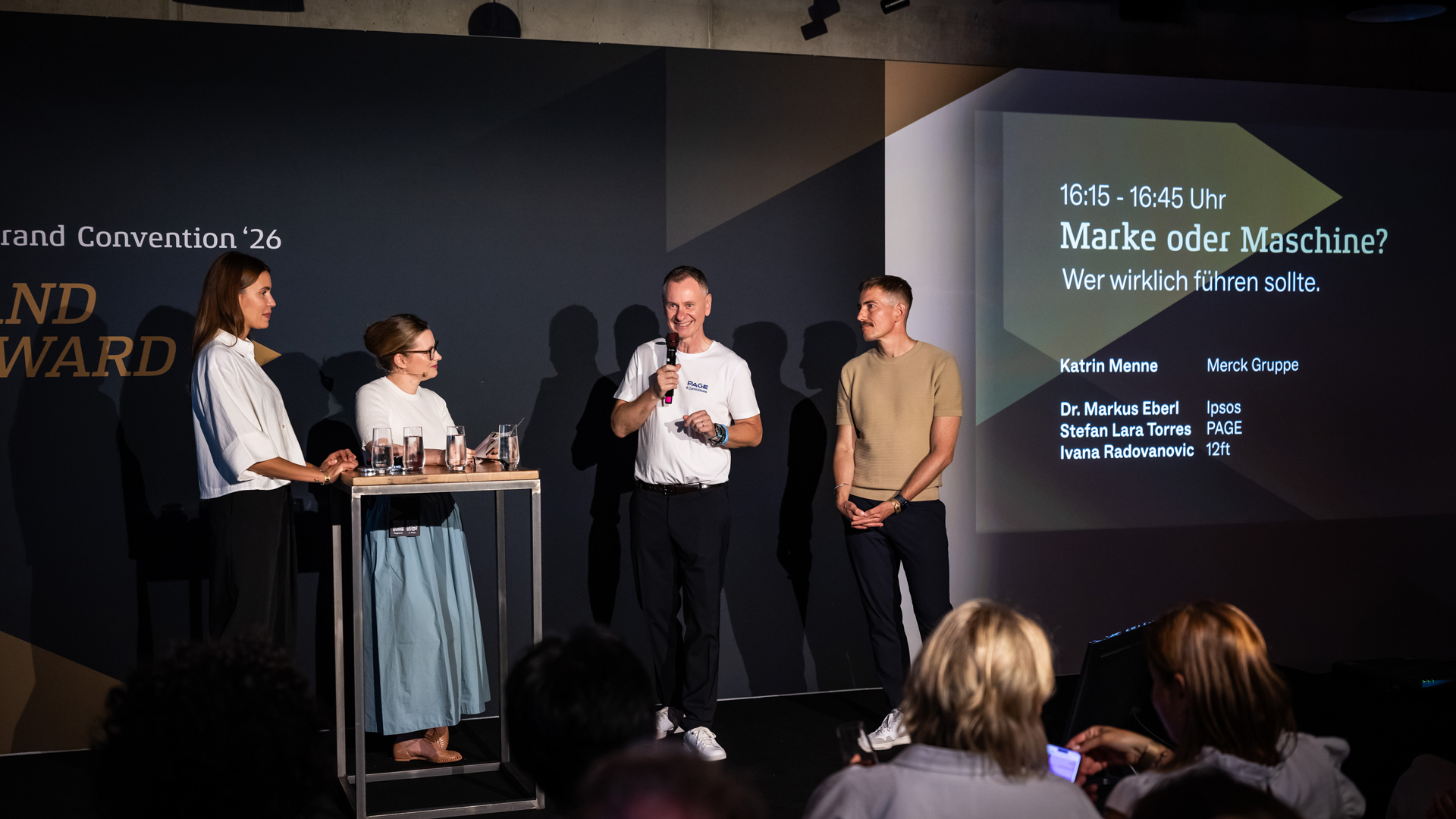
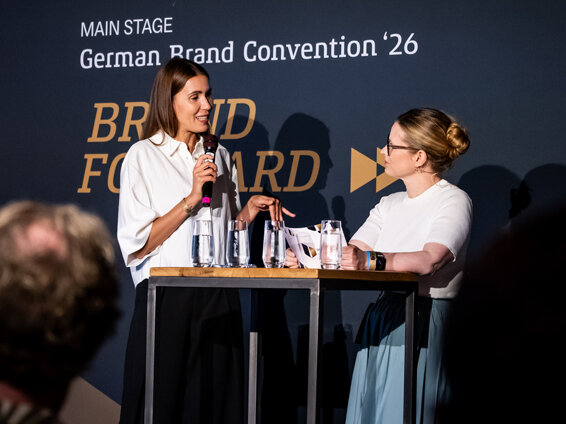
Katrin Menne, Head of Brand & Content Marketing at the Merck Group, posing a clear either/or question to her guests: Does artificial intelligence merely support brand management – or is it already driving it?
Ivana Radovanovic, who has been supporting companies through transformation processes as a brand consultant for over 15 years, believes that humans are ‘still firmly in the driving seat’ and, in the same breath, mentions machines that are already operating autonomously and semi-autonomously. Stefan Lara Torres, Editor-in-Chief & Director of Brand Partnerships at Page, emphasises AI’s role as a tool: “If we stop asking ourselves whether AI is a tool or not, we’ll very quickly become dependent on a system we don’t want to be part of.” Dr Markus Eberl, Chief Analytics Officer at Ipsos, echoes the editor-in-chief’s views. Eberl looks at the debate from a market research perspective and sees the responsibility clearly lying with humans – both for evaluating AI results and for controlling them.
Synthetic personas offer a starting point, not a revolution
The hosts asks Markus Eberl to what extent synthetic data is useful in creative processes – for example, when a chatbot responds based on real survey data, or when it can simulate and replace a customer’s veto in a board meeting. For Eberl, the boundaries between synthetic and real data are still clearly defined. The implication for brand managers is that AI-generated insights are a starting point for brainstorming, not a substitute for genuine creative breakthroughs.
“Yes, modern persona bots can simulate behaviour, but can they also surprise us? Or do they merely reflect training data back to us? And to what extent do they capture change? We should view AI personas as an exoskeleton that supports people in their creativity.”
Efficiency does not automatically lead to success
Ivana Radovanovic has worked for major agencies, developed award-winning AI tools and spoken at key industry events. When asked what has changed most in brand management over the last four years with the advent of generative AI, she replies: “How much time do I have?” The industry professional begins with a negative observation. The collective expectation that chatbots and agents could achieve an incredible amount is putting intense pressure on brand decision-makers. In companies and agencies alike, efficiency is taking centre stage – at the expense of genuine creative ‘wow moments’.
“There’s a huge focus on efficiency and talk about how things are done. But not about what is actually being done. AI currently helps us to reproduce exactly what we were already doing before – only more cheaply and more quickly.”
Radovanovic moves on to the many positive changes in creative work. Greater insight and fewer time-consuming tasks would trigger new processes and encourage people to think in terms of potential. “In this sense, efficiency has an entirely positive effect. The only important thing is that we know how to make good use of the time saved and invest it in lively discourse, genuine action and human creativity.”
Katrin Menne asks Stefan Lara Torres whether design produced by low-threshold AI applications is nothing more than a standardised commodity. “With the tools currently at our disposal, we’re achieving superb results, no question about it. But what does ‘superb’ actually mean? From a market perspective, this level is sufficient for now – for the time being.” Like no other, the PAGE editor-in-chief is so closely connected to the German creative scene and, from this perspective, addresses the decision-makers in the audience:
“We’re churning out a one-size-fits-all product that has no future. To stand out again and be successful, the marketing budget you’re saving now is no longer viable, and you’ll have to spend more money again. So don’t cut back on the creatives; support them in working with AI, but don’t leave them out of the loop.”
In other words: if everyone applies the same performance-driven logic and relies on GenAI in the process, the results will inevitably be similar and brand identities will become diluted. All three panellists agree that perfect texts, perfect images and the well-known ‘AI sloppiness’ may achieve the desired outcome in the short term, but will entail costly differentiation measures in the medium and long term.
Which task should never be delegated to AI
Katrin Menne, who, in addition to her role at Merck, is a long-standing jurymember for the German Brand Awards, poses the concluding and eponymous question: Who will lead? “Despite widespread automation, humans will remain responsible. Machines should never question the meaning and purpose behind things – yet at the same time, there is probably some truth in the saying ‘never say never’. At present, we should remember that we don’t have to hand something over to AI simply because it’s possible – even if we actually enjoy doing it,” replies Markus Eberl. According to Ivana Radovanovic, it is currently not possible to achieve “high-quality results at the touch of a button” using AI alone, which is why she considers human oversight to be essential. The brand consultant recounts a past project with a creative partner and the development of an image generator that was only able to produce good results because ‘the best designers and the best techies’ were involved. Her conclusion: ‘The machine loses out compared to humans.’
Finally, Stefan Lara Torres takes the microphone. Before answering Katrin Mennes’ question as to why companies should still commission agencies at all, he first makes it clear: “It might seem as though I’m fundamentally against AI. On the contrary, I’m in favour of this technological shift, which enables a brilliant new form of creativity. What bothers me, however, is that we are placing ourselves in a position of dependence on major transatlantic players, with democratic values falling by the wayside in the process.” To answer the original question, he explains: “I’ve seen plenty of brilliant work with outstanding messages where I wasn’t in the least bit interested in whether they were created by, with or without AI. I don’t condemn anyone who uses internal chatbots to produce visuals more cost-effectively and quickly, or to develop new business models. However, it’s wrong if creatives are no longer given any opportunity at all to get involved in this field. Hopefully, the EU AI Act will raise widespread awareness of this issue.”
Conclusion: The future lies in balance
Ultimately, all three speakers agree on one point: humans will remain in the driving seat – albeit in different roles. Ivana Radovanovic remains optimistic: “The trick will be to find the right balance between human-machine interaction.” Markus Eberl sums it up: “Humans steer, machines think along with them.” And Stefan Lara Torres is convinced that “a creative person cannot be steered.”
AI is no substitute for brand management, but rather another tool that requires just as much human control as any other before it. Those who take this control seriously will retain their distinctiveness. Those who relinquish it will end up in a sea of sameness.
Four Practical Takeaways
- Manage chatbots and agents deliberately. Autonomous and semi-autonomous decisions made by AI do not happen automatically. Actively determine where control can be relinquished – and where it cannot.
- Focus not just on efficiency gains, but on differentiation. If everyone uses the same efficiency-driven approach, the result is a generic mass of offerings. Genuine differentiation arises where there is a conscious investment in creative talent rather than just in tools.
- Never delegate ultimate human responsibility. Storytelling, empathy and the question of whether something makes sense at all remain tasks for humans. The machine must not be allowed to say ‘no’ – brand managers must do that themselves.
- Practise transparency rather than merely fulfilling obligations. The EU AI Act sets an important minimum standard. However, genuine consumer trust only arises when brands make transparency a principle of their own accord.